Wednesday, 18 January 2012

Telomeres: How Your DNA is Like A Shoelace

At some point, you've probably noticed those little plastic doodads at the end of your shoelaces. Apparently, they're called aglets. These little caps serve to hold together the laces at the end to prevent them from fraying apart over time. It might sound strange, but your shoelaces are a bit like your DNA.

Pictured: DNA (not really)
 DNA, in its most basic form, is a long strand made up of the bases adenine, thymine, guanine and cytosine, which are typically represented by A,T,G and C. The strand exists in a double helix structure, where each base is paired to its appropriate match (A to T and C to G). 

Here, we see the DNA base pairs, as well as DNA in its natural form, the double helix.
When the cell must divide, the DNA is peeled apart, and appropriate base pairs are added to either strand. The result is two identical strands of DNA, which are then separated into two new daughter cells. Perfect.

Except... that's not quite the case. Unfortunately, the DNA replication process isn't quite perfect. Every time the DNA divides and is replicated, a few bases are lost off the end of the strand. That's where telomeres come in.
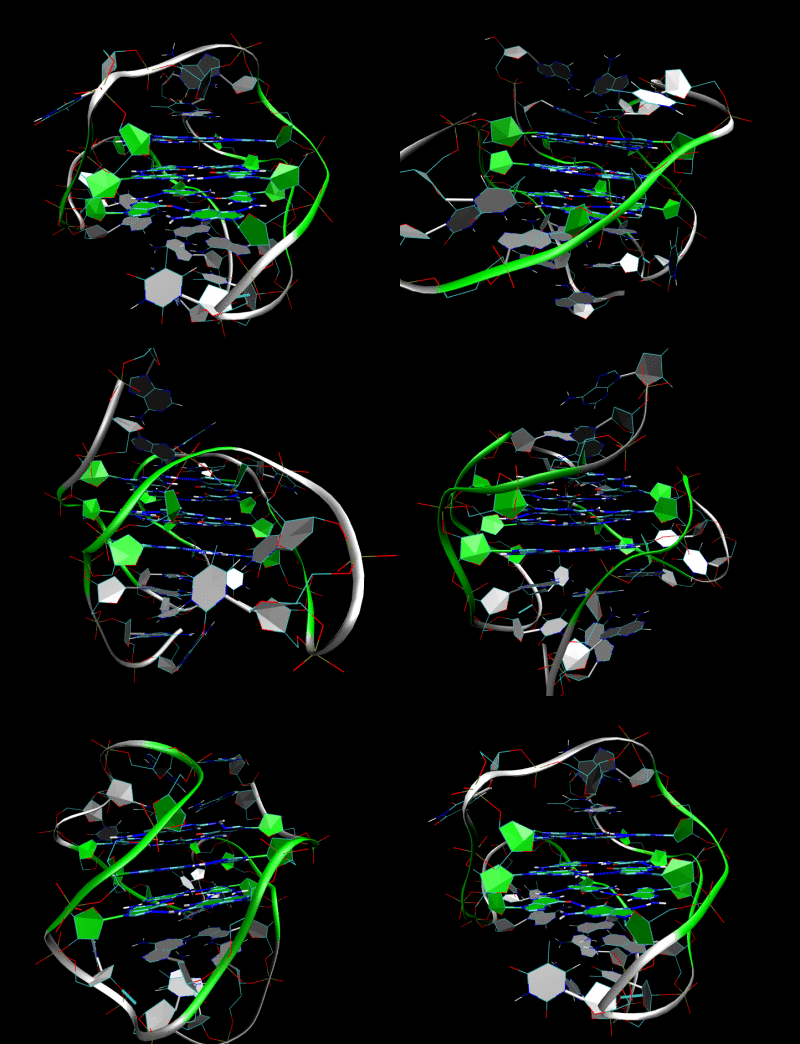
Doesn't look like much, but these things keep your  DNA safe

Telomeres are lengths of repetitive DNA that have no function other than to be missed out in replication. They do not code for anything when the DNA is read by the ribosome, so if they are not present, then the cell, and by extension the body, can still function normally.

What the telomeres do provide is a sort of bumper zone for the DNA replication failure. As previously stated, the replication chops a few bases off the end of the strand each time. If the bases being missed coded for important proteins, then missing them could potentially kill the cell. If this happened in all the cells of the body, then it would barely be able to support itself. However, removal of sections of the telomeres causes absolutely no negative effects towards the cell. If the bases that are missed are from the telomere, the cell can continue functioning as per normal.

So how does this cause ageing? Well, the telomeres are absolutely fine being missed out during every division, but unfortunately, there's only so many times this can happen. Over time, the telomeres are degraded, until eventually there is nothing left. At this point, the bases missed off by replication ARE crucial to the cell. The cells then fail to divide, and slowly, the rate of cell death rises. How does this manifest itself? In the form of ageing. Most interestingly is the time it takes for the telomeres to be entirely degraded. It's around 25 to 30 years, which around the same time ageing begins in the human body.

So there we are. Your DNA is like a shoelace, and the telomeres are like the aglets. When they are there, they keep everything in check.When they are removed, everything starts unravelling.

And then your shoe falls off. 

Tuesday, 10 January 2012

Why Do We Age?

Our medicines prevent many diseases from killing us. Advances in medical science have allowed us to fix damaged organs, like hearts, or in some cases replace them entirely. The further understanding of nutrition provides us with the knowledge we need to stay healthy throughout our lives. But despite all this, there is still no way to defy death permanently. We can prolong life, almost tripling its natural length, but eventually, the human body can no longer support itself.

So why does this happen? Whilst the precise cause of ageing is as of yet undetermined, there are many theories. One theory indicates that the mitochondria, which are the energy production units in our cells, cause damage to the cells over time via the release of harmful by-products. Mitochondria produce ATP (the energy currency of the cell) through several cycles that split glucose down into various compounds, releasing energy in the form of ATP along the way. This process can release electrons which form reactive oxygen species. You may be more familiar with these under the guise of free radicals. These molecules cause damage to several different components of the cell. Over time, this cell damage builds up, and we see the effects of this in the form of ageing.

Another theory is more centred around DNA as the cause of ageing. As you may know, DNA (or Deoxyribonucleic Acid to be precise) is found in every cell in our body and contains the instructions for each one of the cells. The DNA in our cells produce protein, which activate different functions around the body. When a cell divides, a copy of the DNA is made, after which the cell divides in two. The process of replication is balanced by the rate of cell death. In the first part of our lives, as we grow, the rate of cell division is higher than that of the rate of cell death. However, at about 25 years of age, the rate of cell division begins to decline. It is at this point where our bodies start "ageing" as we know it. This decline in division is the result of the degradation of telomeres. These little caps of DNA are fascinating, and I'll be taking a closer look at them in a future posts.

One final theory around ageing implicates insulin as a contributing factor. You probably already know of insulin through its role in diabetes, but studies have shown that it could also cause ageing when combined with a chemical referred to as insulin-like growth factor 1, or IGF-1. IGF-1 can bind to both specific receptors as well as insulin receptors. Many tests have been conducted on a variety of different species that indicate removal of insulin receptors can lead to incredible prolonging in life. An experiment showed that the lifespan of the roundworm species Caenorhabditis elegans could be doubled by mutating the gene that coded for the insulin-like receptor. Since the insulin/IGF-1 pathway is the same within both worms and mammals, this indicates a possible anti-ageing therapy that could extend life permanently.


It's difficult to say exactly if any of these are the one true cause of ageing. It could be that it is a combination of all the different theories, or it could be that one theory in turn stimulates the others. Whatever the case, each theory offers exciting avenues for potential therapies in anti-ageing.


An excellent review on insulin/IGF-1 ageing theories can be found here; http://www.fly-bay.net/journals/cc/BartkeCC7-21.pdf

Monday, 2 January 2012

A Mission Statement

I feel that an introduction is necessary here.

My name is Eddie Johnston, and I am a biologist. At least, I am a student of biology. I'm in my third year of study at the University of Kent.

One of my favourite areas of biology, and to an extent science in general, is the science of immortality. It's incredible to see how in the last hundred or so years, we have dramatically increased life expectancy, by doubling and now almost tripling our natural life span.

Increasing our life span is a result of a combination of different factors. Better medicines prevent common disease from killing us. A better understanding of nutrition has improved our diets, making us healthier. Our society has changed, providing us with the food we need to survive at our convenience. We, as a species, have beaten nature at its own game.

But that's not the end of the battle. Regardless of how far we have stretched our lives out, humans eventually succumb to death. Whether it be through disease, accidents or simply old age, one way or the other life always comes to close. But recent scientific research is beginning to change that.

Over the coming weeks and months, I'm going to be looking at immortality science. Starting with the basic principles of ageing, I intend to go on to look at current research being done to prevent death through age, and finally look at where science may take us in the future. Along the way, I'll be taking time to look at the social and ethical implications brought on by the prospect of immortality.

So, let's get started.